The Community Show Planner
Promise a running time with the changes in it, divide the rehearsal hours you really work, tape the grid from the centerline, cut props before contingency, and round the rake's floors up
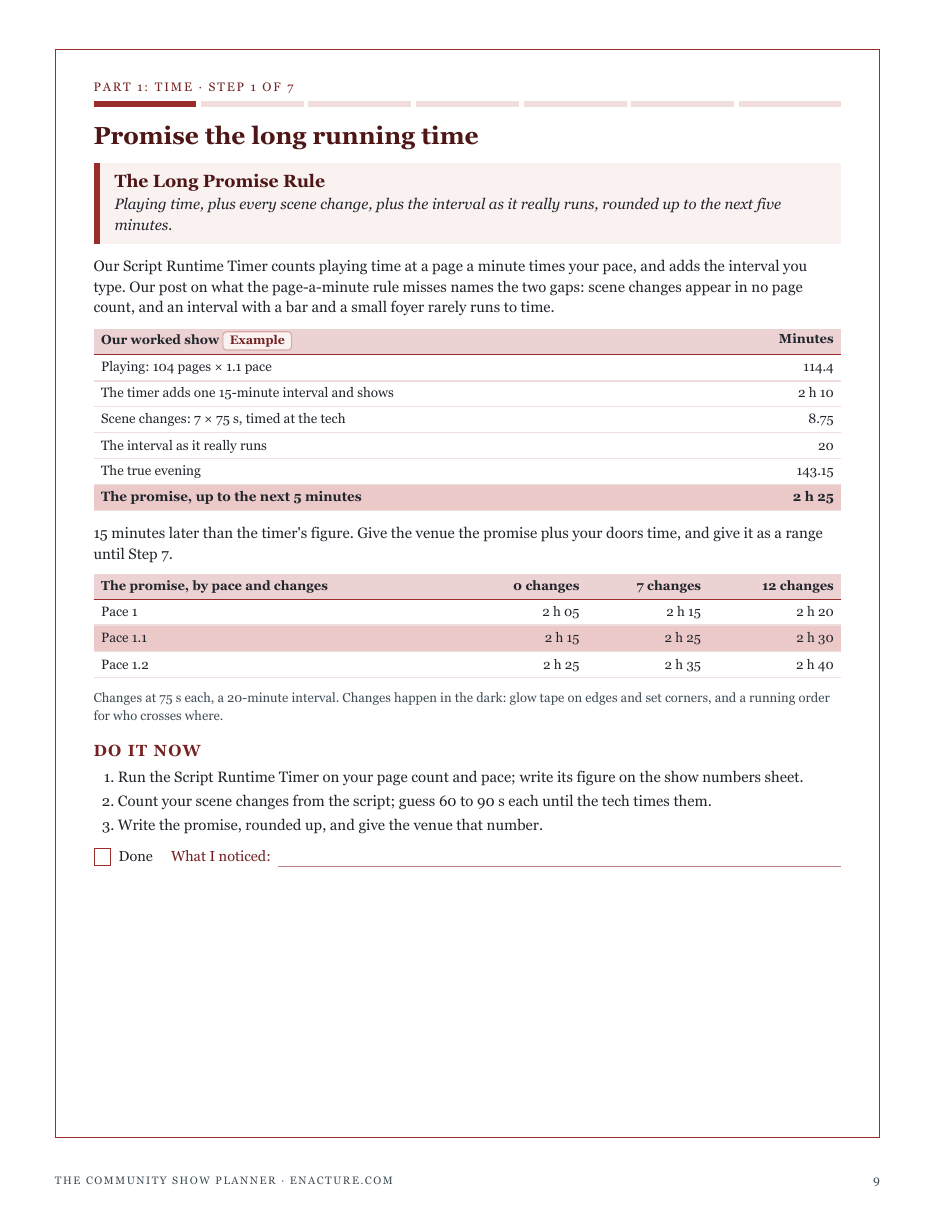
StageCraft's free calculators each answer one production question and leave a number out. The Script Runtime Timer adds a nominal interval to page-a-minute playing time and never counts scene changes. The Rehearsal Scheduler divides booked hours by pages. The Blocking Grid Generator counts from one wing, so its center zone drifts off the centerline. The Prop Budget Planner reports an overrun that already includes contingency. The Sightline Calculator prints floor heights to four decimals of a foot. The Community Show Planner joins them up in seven steps. In the worked example a 104-page script the timer reads as 2 h 10 needs a 2 h 25 promise once seven scene changes and a 20-minute interval are in it; 57 booked rehearsal hours are 44 h 20 of real scene work, shared by what each scene needs in 15-minute blocks; a $76.05 prop overrun at 15% contingency needs only $66.14 of purchases cut, and borrowing one line closes it; and a raked hall's floors, rounded up to the half inch, never fall below the sightline, where cutting each step to the inch below leaves the back row 3.88 in short of a 4-inch clearance. Every figure is computed from the site's own calculators; the shows, halls and prices are examples, and the factors and splits are rules of thumb. The rake pages are geometry only: no load rating, seat count or build method, and the rows high enough to need a guard are flagged for a competent person and your venue. Rigging, flying, pyrotechnics, stage combat, haze and electrical work are out of scope. Included: 24 printable pages, four working pages, a reference table and quickstart, and a personalised sheet worked from the numbers you enter in the calculators.
Look inside
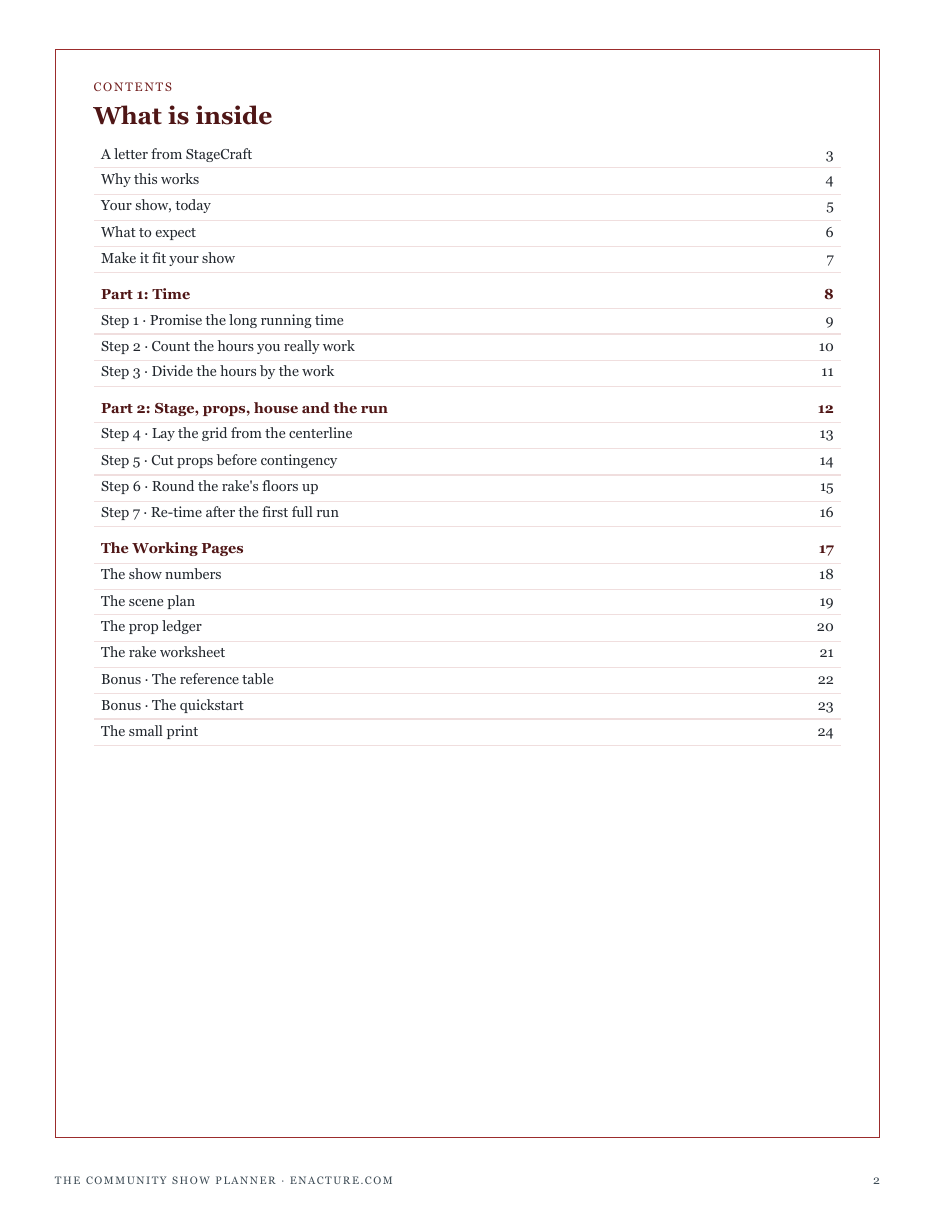
Two full pages from the planner, exactly as printed. Click either to read it at full size before you decide.
What is in it
- The Long Promise Rule: playing time plus every scene change plus the interval as it really runs, rounded up to five minutes
- The Working Hours Rule: whole calls, the tech and dress reserve kept whole, and the hours you work once the late start, break and notes come out
- The Work Weight Rule: scenes weighted by the work they need, not their pages, split into blocking, working and running in 15-minute blocks
- The Centerline Rule: where the grid tool's center zone really sits, and a grid taped out from a chalk centerline with zone lines in feet and inches
- The Cut Before Contingency Rule: the purchases to cut, rounded up, and the fewest lines to borrow, proved by re-running the prop planner
- The Floor Up Rule: each row's floor rounded up to a buildable increment, steps taken from the floors, and the rows high enough to need a guard flagged
- The Re-Time Rule: the pace measured at the first full run, a new promise for the venue, and the tech reserve protected
- Four working pages: the show numbers, a scene plan, a prop ledger and a rake worksheet
- A reference table of the site's four sample halls built floor up and the rake levers priced, plus a quickstart
- A personalised sheet worked from the figures you enter in the runtime, rehearsal, grid, prop and sightline calculators
- ✓ 24 printable pages
- ✓ 10 sections, worksheets and templates
- ✓ A second PDF worked out from the numbers you enter
- ✓ No account needed, just an email address
- ✓ Instant download; link valid 7 days
Price includes any taxes. Sold by GrabURL, who handle checkout and support. The charge appears on your statement as GrabURL.
The planner picks up where the free Sightline & Riser Calculator leaves off. The calculator gives each row's floor height to four decimals of a foot; the planner rounds each floor up to a height you can build and flags the rows that need a guard. It uses the Script Runtime Timer for a running time you can promise, the Rehearsal Scheduler for the hours you really work, the Blocking Grid Generator for a grid laid from the centerline, and the Prop Budget Planner to close an overrun. The rake pages are geometry only: structure, load rating and guards are for a competent person and your venue.